
We post updated questions from the community every week
JCC 2026 Operating Referendum – Frequently Asked Questions
Why is JCC asking for an operating referendum again after last year's referendum failed?
Following last year's unsuccessful referendum, JCC made more than $550,000 in budget adjustments for the 2026-27 school year. These included staffing reductions, reductions to supplies and curriculum purchases, changes to activities and transportation, and other operational reductions.
Even after those difficult decisions, JCC continues to deficit spend. The district's financial challenges are being driven by several factors, including declining enrollment, rising costs, state funding that has not kept pace with inflation, declining compensatory and special education revenues, and new state mandates that are not fully funded.
JCC is projecting approximately 60 fewer students over the next four years, which would result in roughly $600,000 less in annual revenue by the fourth year. Without additional revenue, further significant budget adjustments will be necessary.
What exactly is JCC asking voters to approve?
JCC currently has an operating levy of $460 per student, which generates approximately $547,000 annually and does not include annual inflationary increases.
On November 3, voters will be asked to revoke the current $460-per-student levy and replace it with a $1,460-per-student levy for 10 years with inflationary increases. The new levy is estimated to generate approximately $1.67 million annually for JCC Schools.
Operating referendum revenue supports the district's General Fund and helps pay for the everyday operation of our schools, including classroom instruction, student support, academic programs, transportation, technology, safety, and extracurricular opportunities.
How much would the referendum cost taxpayers, and how does it affect agricultural property?
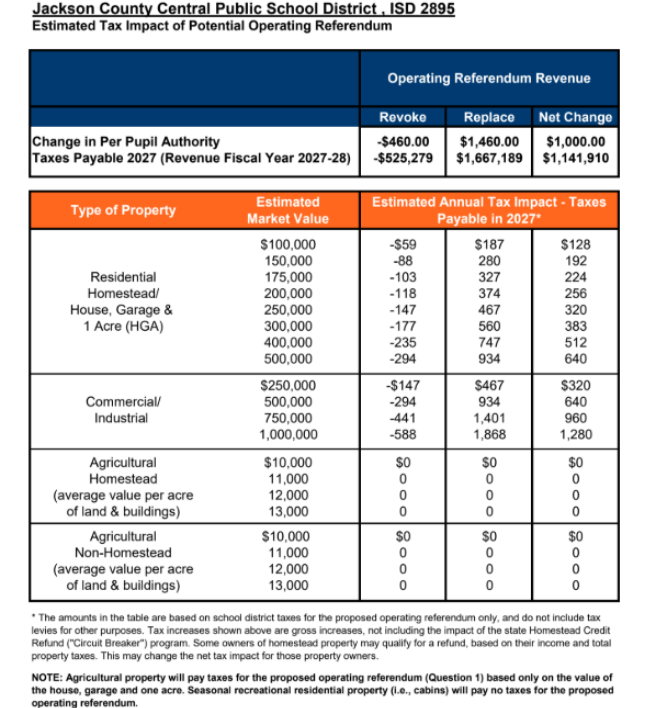
For a $200,000 home, the estimated net tax increase is approximately $256 per year, or about $21 per month.
An operating referendum is different from a building bond when it comes to agricultural property. For agricultural homestead property, the operating referendum tax is generally based on the value of the house, garage, and one acre, rather than the value of the entire farm property.
We encourage residents to look at their individual tax-impact information because the actual amount will depend on the referendum market value of their property.
Why doesn't JCC close the pool and use that money to help solve the budget problem?
This is an important question because school district funds can be confusing.
The JCC pool is not funded through the district's General Fund. The district's share of pool operations—approximately $73,000-$74,000 annually—comes from Fund 4, the Community Education Fund. Community Education has separate revenue sources and accounting requirements from the General Fund. Minnesota law requires Community Education revenues to be maintained within the Community Service Fund and limits how those dollars may be used.
Therefore, closing the pool would not result in $73,000-$74,000 becoming available to pay for General Fund expenses such as classroom teachers, instructional programs, or other regular school operations. The dollars currently supporting the pool cannot simply be transferred to the General Fund to solve JCC's operating deficit.
The pool's long-term operation and facility needs are legitimate issues for the district and community to continue discussing, but closing the pool is not a solution to the General Fund deficit that the operating referendum is intended to address.
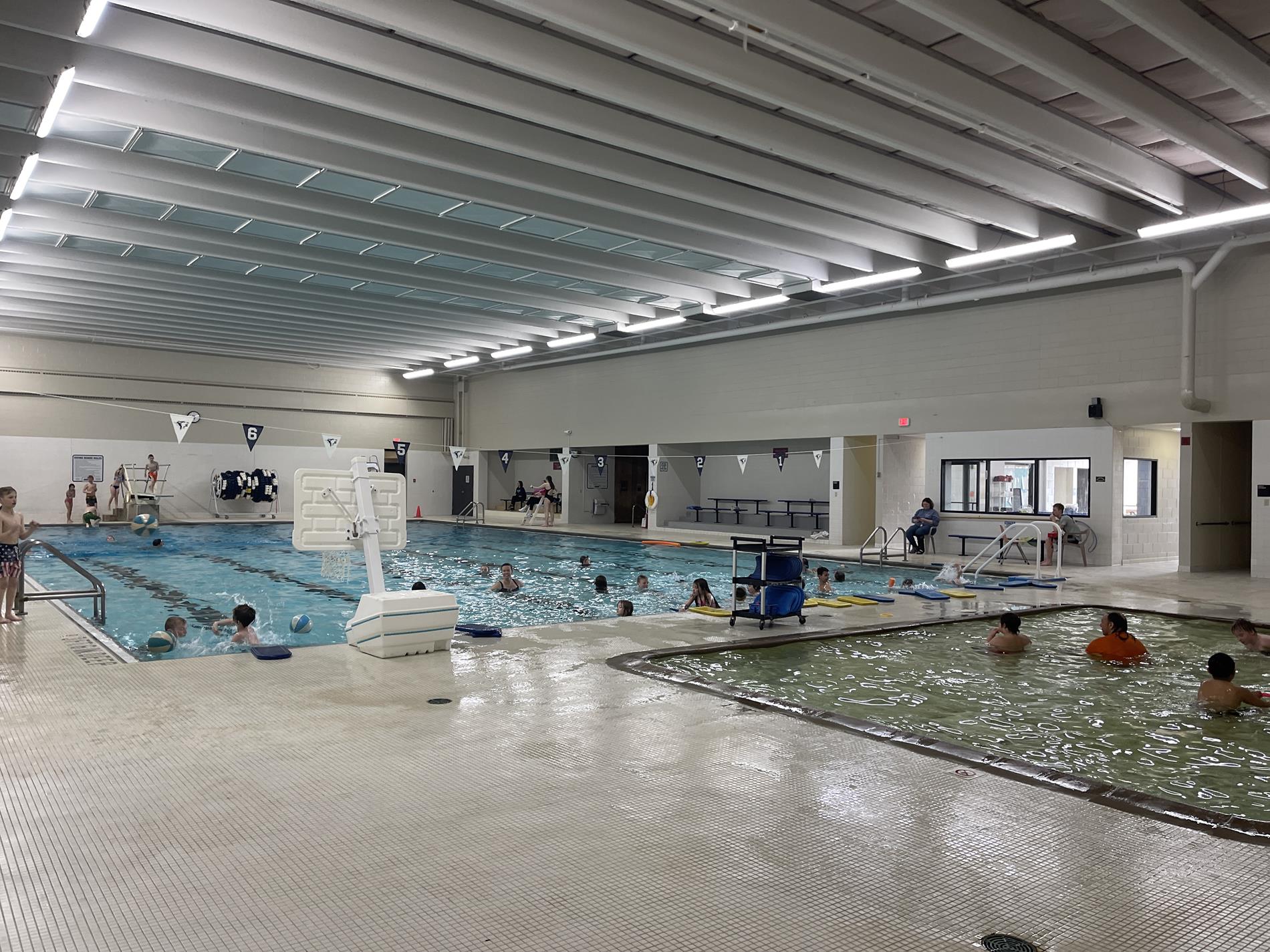
JCC Pool Funding: Know the Facts
There have been questions about the JCC pool and its impact on the district’s financial challenges.
JCC Schools and the City of Jackson share the cost of operating the pool. JCC currently pays approximately $73,000 per year, with those dollars coming from the Community Education Fund, which receives revenue from pool admissions, childcare, swimming lessons, and other program fees.
Pool operations are not currently supported by the district’s General Fund. The last time General Fund dollars were used for the pool was the 2020–21 school year. By law, school districts cannot simply transfer Community Education or Food Service funds into the General Fund. Therefore, closing the pool would not make the $74,000 available to address the General Fund deficit associated with the referendum.
The age of the pool remains a concern. If major equipment or parts of the facility fail and require substantial repairs, the continued operation of the pool would need to be reevaluated.
JCC Schools will continue sharing facts about district finances as we approach the November 3 referendum.
What happens if the operating referendum does not pass?
If the referendum does not pass, the financial problem does not go away. JCC would need to make at least $800,000 in additional budget adjustments to maintain the School Board's 12.5% General Fund balance policy.
Because approximately 70% of the district's budget is dedicated to employee salaries and benefits, it becomes increasingly difficult to make reductions of this size without affecting students.
Future adjustments could include fewer staff members, larger class sizes, reduced academic programming, fewer extracurricular or co-curricular opportunities, and reductions in services throughout the district.
JCC has already made more than $550,000 in adjustments for this school year. Another round of reductions would require increasingly difficult decisions about the programs, services, and opportunities we are able to provide our students.
Election Day is Tuesday, November 3, 2026. We encourage every resident to learn about the referendum, ask questions, and make an informed decision.
What is the difference between a school referendum and a school levy?
A referendum is the process of asking voters to approve a funding question. A levy is the authority to collect property taxes to generate that revenue.
For example, JCC's November 2026 operating referendum asks voters whether the district should have additional operating revenue authority. If approved, that authority results in a property tax levy. Minnesota's operating referendum program allows districts to obtain voter approval for General Fund revenue beyond other statutory funding.
Not every school levy requires a referendum. Some levies are authorized through state law and approved annually by the School Board, while operating referendum levies and certain capital levies require voter approval.
Why do some school funding questions last 10 years while others last 20 years, like in neighboring school districts?
It depends primarily on the type of funding question. An operating referendum such as JCC's is limited to a term of no more than 10 years under Minnesota law.
A building bond is different. Bonds finance major construction or renovation projects and are repaid over a longer period. Twenty-year repayment schedules are common, although school bonds can have other repayment periods. Thus, when residents hear about a neighboring district having a "20-year referendum," it may actually be a bond issue rather than an operating referendum.
JCC's 2026 question is an operating referendum with a 10-year authorization, not a 20-year building bond. However, new legislation was passed recently allowing school districts to automatically renew the operating levy in place without voter approval. Therefore, this levy could last for twenty years. However, nothing can be changed, including length of the levy or the amount, if it is renewed.
What are the different types of school levies, and what is each one used to fund?
For purposes of explaining JCC's situation, three major types are particularly important:
Operating referendum levy: Provides General Fund revenue for day-to-day educational operations, including staffing, instructional programs, class sizes, student services, utilities, transportation and other operating expenses. JCC's November 2026 question is this type of referendum.
Capital projects levy: Provides designated funding for capital-related purposes such as technology, curriculum, transportation vehicles and certain facility improvements. JCC proposed a $250,000-per-year capital projects levy in November 2025, which was not approved. Minnesota law restricts capital project levy proceeds to approved capital purposes.
Building bond/debt-service levy: Used to repay bonds issued for major construction, additions, renovations or other substantial facility projects. These frequently involve longer repayment periods.
What is different about this year's ballot questions compared to last year?
In November 2025, JCC had two local school funding questions:
An operating referendum that would have replaced the existing $460-per-pupil authority with $820 per pupil, adjusted annually for inflation, for 10 years.
A capital projects levy that would have generated approximately $250,000 annually for 10 years.
Both questions failed.
In November 2026, JCC has only one local funding question: an operating referendum. There is no JCC capital projects levy question this year. The operating referendum is asking voters to revoke the $460 per student levy (that has two years left) and replace it with $1460 per student for 10 years with an annual inflationary increase.
There is also a completely separate statewide constitutional amendment concerning the Permanent School Fund on the November 3, 2026 ballot.
What is the statewide funding question on this year's ballot? If I vote for other election items but leave that question blank, is it counted NO?
Yes. Minnesota voters will decide one proposed constitutional amendment titled "Increasing funding to school districts." It asks whether the Minnesota Constitution should be amended to increase distributions to school districts from the Permanent School Fund without raising individual income or property taxes, effective July 1, 2027.
Importantly, leaving this constitutional amendment blank has the same effect as voting NO. Constitutional amendments must receive a majority of all voters participating in the election, not merely a majority of voters who answer the amendment question. The Secretary of State specifically states this on its 2026 ballot information.
This rule applies to the state constitutional amendment, not to JCC's local operating referendum. If you do not cast a vote for the JCC Operating Referendum, it remains neutral. It will not count as a YES or as a NO.
How much funding would the statewide question provide for our district, both annually and on a per-student basis?
Our previous JCC information estimated that passage would provide JCC with approximately $36,000 in additional annual revenue.
What role would that funding play in the district's overall budget and long-term financial outlook?
The additional approximately $36,000 would be helpful General Fund revenue, but it would not solve JCC's structural budget challenge. For perspective, JCC implemented more than $550,000 in adjustments for 2026-27 and still adopted a preliminary budget showing approximately $418,000 in deficit spending. The district also continues to face declining enrollment and increasing expenses.
Therefore, Permanent School Fund revenue would provide additional ongoing support, but it would represent only a small portion of the district's overall financial need and would not replace the revenue contemplated by the JCC operating referendum.
Why is the district asking voters for additional funding now?
Several factors have combined to create a structural financial challenge for JCC:
Declining student enrollment reduces state and local revenue.
State funding has not kept pace with long-term inflation and increasing district costs.
Health insurance and other employee costs have increased by 20% last year.
Compensatory and special education revenues have declined by more than $110,000.
New state requirements have added costs that are not always fully funded. For example, the district is now mandated to pay out approximately $120,000 for unemployment for hourly workers in the summer and for MN Paid Leave.
The district's existing $460-per-pupil operating referendum does not include an inflation adjustment and expires after the 2027-28 school year.
More than $550,000 in budget adjustments were made for 2026-27, yet the district's preliminary budget still showed approximately $418,000 in deficit spending.
Approximately 70% of district expenditures are salaries and benefits, which also means continued large reductions ultimately become difficult to accomplish without affecting staffing and student programming.
How was the $1,460 per-student amount decided on for this referendum?
The $1,460 per-student amount was developed through financial analysis and long-term planning, rather than selecting an arbitrary number.
JCC Schools works closely with Ehlers, a financial consulting firm that works with many school districts throughout Minnesota. The district and its financial consultants reviewed recent spending and revenue trends along with approximately 3–5 year projections for enrollment, revenues, and expenditures.
Based on those projections, $1,460 per student was recommended to the School Board as an amount that would give JCC the best opportunity to achieve greater financial stability throughout the term of the levy while minimizing the magnitude of additional budget reductions.
Passing the referendum would not eliminate the need for future adjustments. JCC's enrollment is projected to continue declining, and school funding is closely tied to enrollment. As enrollment decreases, the district will need to continue a process of "right-sizing" by gradually adjusting staffing, programs, and expenditures to correspond with the number of students being served.
The goal of the $1,460 amount is therefore not to eliminate all future reductions or significantly expand district spending. It is intended to provide a more stable financial foundation so that necessary adjustments can be made strategically over time rather than through larger, more disruptive budget reductions.
What would the additional $1.5 million in funding allow the district to do add, subtract or maintain?
The primary purpose should be characterized as maintain and stabilize, rather than substantially add new programs. The operating referendum is intended to help JCC:
Maintain reasonable class sizes.
Maintain current academic programs and course offerings.
Maintain student services and opportunities.
Reduce the need for additional significant staffing and program cuts.
Improve long-term General Fund stability.
Replace an existing $460-per-pupil referendum that will otherwise expire.
Provide an inflationary adjustment so the value of the levy does not continue to erode over time.
The district's earlier referendum materials similarly described operating referendum revenue as supporting class sizes, academic programs and long-term financial stability. The school board policy regarding the fund balance states it must not be less than 12.5%. We are projecting to decrease to 13.1% at the end of the 2026-27 school year
What were the largest 2-3 budget reductions included in the $550,000 of cuts implemented for the current school year, and why were those areas selected?
The largest category was staffing, which is expected because salaries and benefits account for approximately 70% of district expenditures.
Documented staffing reductions included:
Several elementary teaching positions.
A high school social studies position.
A portion of the high school choir program.
Physical education staffing.
Middle school staffing.
Library paraprofessional support.
The School Resource Officer position.
Other reductions included fewer assistant coaching positions, activity and transportation reductions, reduced supplies, technology/curriculum reductions, reduced extended contracts and limits on administrator travel.
If the referendum passes, how will the district be accountable for the use of funds?
Operating referendum revenue becomes General Fund revenue and is subject to the same financial controls as other district General Fund money. That includes:
School Board approval of the annual district budget.
Public School Board meetings and financial reports.
Annual independent financial audits.
Minnesota Department of Education accounting requirements.
Public access to district budgets and audit reports.
The district currently publishes annual financial reports and independent audit information.
If this doesn't pass, what could approximately $800,000 in reductions look like?
It is important to distinguish between examples of areas that could be considered and decisions that have actually been made. No final $800,000 reduction package has been approved.
Staffing: Because approximately 70% of district expenditures are salaries and benefits, an $800,000 reduction would be extremely difficult to accomplish without examining staffing. Possible effects could include fewer teachers, paraprofessionals or support positions; larger class sizes; fewer sections of courses; or combining responsibilities.
Facilities and maintenance: The district could examine reductions or deferrals in maintenance, equipment replacement and facility expenditures where legally and practically possible. However, restricted funds such as LTFM or other designated capital funds cannot simply be transferred to solve a General Fund deficit.
School or facility closure: A school closure could theoretically be evaluated as part of a major restructuring effort.
Activities and student opportunities: Previous cuts have already included fewer assistant coaches, transportation changes and reductions to extracurricular programs. Further reductions could involve activities, staffing, transportation, course offerings or other opportunities, depending on School Board priorities.
Practical examples: An $800,000 reduction could mean some combination of fewer employees, larger classes, fewer elective sections, reduced extracurricular offerings, reduced support services, increased fees, delayed purchases or maintenance, and changes in how buildings/programs are operated.
How does the referendum affect agricultural property owners? Why are only the house, garage and one acre of farmland included this go-around?
Because JCC's 2026 question is an operating referendum, Minnesota law calculates the tax using referendum market value.
For agricultural homestead property, referendum market value includes the house, garage and surrounding one acre, but excludes the remaining agricultural land.
How much would this referendum cost the average homeowner, and how is that amount calculated?
The example we have consistently used in JCC referendum materials is:
A $200,000 residential property would see an increase of approximately $21 per month, or approximately $256 per year.
The actual amount depends on the property's referendum market value. The tax is not calculated based on the homeowner's income, mortgage balance or purchase price; it is based on the property's taxable/referendum market value and the levy calculation.
Again, for agricultural homestead property, only the house, garage and one acre are included in referendum market value. Minnesota law establishes that distinction.
JCC also has a property-tax calculator available as part of its 2026 referendum tax information so individual taxpayers can estimate their particular impact. CLICK HERE for the tax impact calculator. Also, see chart below for tax impact.
How does our district's funding compare to neighboring school districts, and how does that affect the opportunities we can provide students?
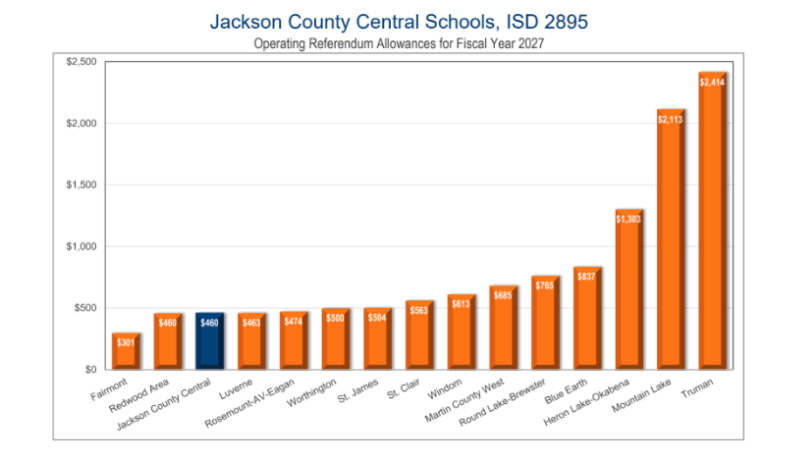
We have previously discussed that JCC's existing $460-per-pupil operating referendum is comparatively low and that the proposed operating referendum would move JCC closer to neighboring districts in locally approved operating revenue. See the Chart below.
School district health insurance can be complicated, but this is how our coverage works and what JCC has been doing to manage these expenses.
Currently, JCC employees can choose from four levels of health insurance coverage, with premiums varying based primarily on the deductible and coverage level selected. Current premiums range from approximately $929 to $1,382 for single coverage and $2,127 to $3,213 for family coverage per month.
The amount the district contributes toward an employee's health insurance is established through collective bargaining agreements, which are typically negotiated every two years. For example, under the current teacher agreement, the district contributes $9,448 toward single coverage and $13,879 annually toward family coverage per year. Employees are responsible for costs above the district contribution based on the plan they select.
JCC currently works with a local insurance broker who assists the district with the insurance bidding process. Every two years, during a bid year, the district has the opportunity to seek proposals from insurance providers and evaluate different plan designs. The broker also works with the district and our insurance committee to identify options that may reduce costs while maintaining appropriate coverage for employees. Next spring will be another bid year for JCC.
We also have a district insurance committee made up of employees from throughout the district. The committee reviews claims and premium information, asks questions, considers different plan options, and provides input to help the School Board make informed decisions regarding health insurance.
One of the challenges JCC faces is the size and makeup of our insurance group. A relatively small percentage of our employees participate in the district's health insurance plan, which creates a smaller insurance pool. In addition, we have experienced some higher-cost claims in recent years. Both factors can affect how insurance companies evaluate our group and the premiums they offer. Along with rising healthcare costs across the insurance industry, these factors have contributed to premium increases of approximately 20% and 15% over the past two years.
Because health insurance represents a significant district expense, we continue to look for ways to contain these costs. This fall, our insurance committee will meet with two different brokerage companies to compare their services, strategies, and approaches. The committee will then recommend which broker should represent JCC as we prepare to seek competitive insurance bids next spring.
We recognize that health insurance costs affect both our employees and the district's overall budget. Our goal is to be diligent in reviewing the market, comparing options, and finding the best combination of competitive pricing and quality coverage for our employees.
Question From A Citizen: A number of activities were cut dramatically as a result of the budget shortfall in the last year. Yet in the FAQ I see little sign that any of these would be restored, even if we contemplate a large increase in taxes. Would the School Board restore these cut programs if the referendum passes?
Answer: I do not like saying this but the answer is that it depends. While passage of the referendum would help provide greater financial stability for JCC Schools in the years ahead, it would not necessarily provide enough additional revenue to restore every program, activity, or position that was reduced. The administration and School Board would carefully evaluate previous reductions and determine which programs or services could be restored while maintaining the district's long-term financial stability. Our goal is to provide the best possible educational opportunities for our students while remaining responsible stewards of taxpayer dollars.
How are farmland owners assessed if they do not have a house and garage on the property?
If an agricultural property owner lives in Iowa (or elsewhere) and owns farmland in Minnesota that is classified as agricultural land, the farmland itself does not pay taxes toward an operating referendum levy. Under Minnesota's referendum tax provisions, agricultural land beyond the house, garage, and one acre is excluded from taxation for operating referendum levies.
As a result, an owner of agricultural land with no qualifying residence on the property would generally pay no taxes toward the operating referendum levy, regardless of the amount of agricultural acreage owned.
Why does JCC need a referendum? Are other schools facing the same situations?
According to the Minnesota Secretary of State, there are 85 school district ballot questions across Minnesota for the November 3 election. Operating referendum questions are among those appearing on ballots around the state.
Here are examples of the per-student operating referendum amounts being proposed by several Minnesota school districts this fall:
• Pipestone Area: $1,500/student
• Benson: $1,410.70/student
• Alexandria: $2,225/student
• Lake Park Audubon: $1,683.10/student
• Ortonville: $1,050/student
• Henning: $2,180/student
• Jackson County Central: $1,460/student
JCC’s November 3 question asks voters to revoke the district’s current $460 per-student operating levy and replace it with $1,460 per student.
We encourage everyone to learn about the referendum, ask questions, and become informed before voting on November 3.
Our Students. Our Community. Limitless Possibilities.
Did You Know - Per Pupil Funding
Another way to understand JCC’s financial picture is to look at how much school districts spend per student.
Here is a comparison of per-pupil spending based on district expenses, listed from lowest to highest:
• Worthington: $13,870
• Fairmont: $14,091
• Jackson County Central: $14,226
• Murray County Central: $14,296
• Windom: $14,490
• Pipestone Area: $14,766
• Martin County West: $15,147
• Luverne: $15,721
• Benson: $16,015
• Minnesota Statewide Average: $16,246
• Heron Lake-Okabena: $18,398
These numbers provide some perspective on how JCC manages the resources available to our district. JCC spends approximately $2,020 less per student than the Minnesota statewide average.
Even while operating below the statewide average, JCC continues to provide a wide range of academic programs, student services, activities, athletics, career and technical education opportunities, and other experiences for our students.
We believe these numbers demonstrate that JCC carefully manages its financial resources while working to get the most out of every dollar for our students and families.
As we continue sharing information about the November 3 operating referendum, we encourage everyone to review the facts, ask questions, and become informed before voting.
Our Students. Our Community. Limitless Possibilities.
One question we have received about the November 3 operating referendum is how the annual inflationary increase is determined.
 The Minnesota Department of Education (MDE), not the JCC School Board, determines the annual inflationary adjustment using the Consumer Price Index (CPI).
MDE currently projects an average inflationary increase of approximately 2.2% annually between FY 2028 and FY 2035.
What does this mean for your property taxes? If JCC's student enrollment declines by approximately 2% annually, the reduction in students would offset much of the projected inflationary increase. Under those assumptions, residents could see minimal, if any, additional tax increase from the inflation adjustment, assuming property values and other factors remain relatively stable.
Why is this important? The inflationary adjustment helps JCC Schools keep pace with rising costs while declining enrollment continues to affect district revenue.
 November 3, 2026 – Be Informed. Make Your Voice Heard. VOTE!
Question From A Citizen: Is JCC one of the only schools going out for an operating referendum this year? If so, is there something that JCC is doing incorrectly? Answer: No, JCC is certainly not alone. Across Minnesota, many school districts are experiencing financial challenges and asking their communities for additional operating revenue. In fact, approximately 30 Minnesota school districts are seeking operating referendum approval in the November 3, 2026, election. There are several reasons districts are facing these challenges. State education funding has not kept pace with inflation over the past 20 years, while expenses for staffing, transportation, utilities, insurance, and other operational needs continue to rise. Additionally, new state mandates have increased costs without always providing sufficient funding to cover them. At JCC, declining enrollment has created another significant challenge. Because much of our state funding is based on student enrollment, fewer students means less revenue, even though many of our expenses remain relatively unchanged. Our current operating referendum of $460 per pupil also does not include an inflationary adjustment. The School Board and administration recognize our responsibility to manage taxpayer dollars carefully. We made more than $550,000 in budget reductions for the 2026–27 school year, yet the district continues to operate with a projected deficit. We also recognize that we must continually evaluate our staffing, programs, facilities, and operations to ensure we are using our resources efficiently. Asking for an operating referendum does not, by itself, indicate that a district is being mismanaged. However, it is fair for taxpayers to ask questions about district spending, financial decisions, and long-term planning. We welcome those questions and encourage residents to review the district's financial information as they prepare to vote on November 3. Here are some examples of other school districts who are going out for an operating referendum this fall. JCC's request for $1460/student is comparable with other districts around the state. | |
 | |